


RADiUM, PARADOX, OXYGEN and the anonymous pirates who put a recording studio inside our bedrooms.
You opened the folder. Inside were files you barely understood, the executable, maybe the crack, and almost always this:
readme.nfo
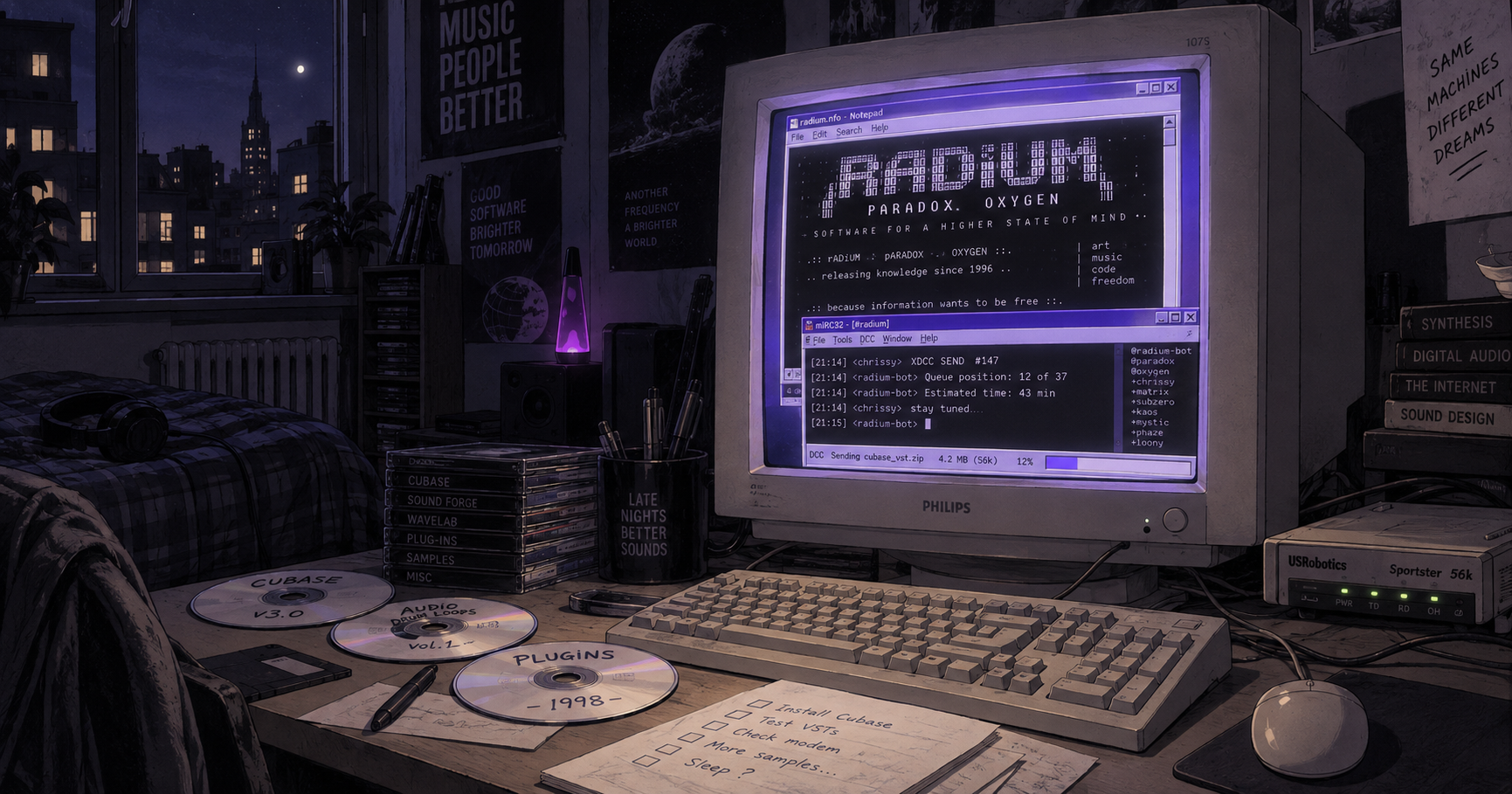
You opened it with a text editor and the matrix appeared: a wall of characters that suddenly became a huge logo made entirely of letters, numbers and symbols.
RADiUM.
PARADOX.
OXYGEN.
Then you scrolled down. Software version, release date, installation instructions, a few jokes, the greetz to other crews and a handful of nicknames.
Sandor. Deepz0ne. Estrayk.
Who the hell were these people?
We had no idea and, in most cases, we probably never would. That was part of the beauty of it.
These people could reach thousands of computers without ever showing their faces. Ego existed, of course: crews raced to release first, challenged each other, fought and took pride in the quality of their work. But the name that finally entered your home was still the name of the group: PARADOX, RADiUM, OXYGEN.
To understand what they meant, you have to go back to the late 1990s, when the computer was becoming a recording studio. Not all at once: piece by piece.
Cubase, Sound Forge, WaveLab, ReBirth, ReCycle. Then the first plug-ins, Waves, TC Electronic.
In 1996 Steinberg introduced VST into Cubase, and suddenly effects, mixers and automation began living on the screen. Virtual instruments would follow soon after. Every year, the computer seemed to swallow another piece of the studio.
For anyone making electronic music, it felt like science fiction.
There was just one problem: it cost a fortune.
In 1998, Cubase VST sold in the United States for $399, while the VST/24 version cost $799. Sound Forge was around $500. A Waves Gold Bundle could cost more than $2,000.
Converted roughly into Italian lire, that meant anything from several hundred thousand lire to several million. And you still needed the computer, the RAM, the hard drive, the audio interface, maybe a MIDI keyboard.
Now imagine the scene. You are seventeen.
“Dad, I need seven hundred thousand lire.”
“For what?”
“Cubase.”
“What’s Cubase?”
“A sequencer.”
“What’s that?”
“I make music with it.”
“Don’t you already have a keyboard?”
End of negotiation.
It was not necessarily a matter of having unsympathetic parents. It was genuinely difficult to explain what you were asking for.
Software had none of the reassuring physical presence of an instrument. With seven hundred thousand lire you could buy a keyboard, an amplifier, something you could actually put on the table. Instead, you were asking for a huge amount of money for a box containing a CD that, once installed, would become a collection of windows on a monitor.
And even if you had the money, there was another question: where did you even buy it?
No instant downloads, no PayPal, often no credit card either. Specialist dealers, distributors, well-stocked music shops, phone calls, orders, waiting.
Then one afternoon a friend would show up and say:
“I’ve got Cubase.”
And everything changed.
Maybe he had a burned CD with AUDIO 4 or CUBASE + PLUGINS written on it in marker.
Inside you found what you were looking for, plus fifteen other things you had never even heard of. Discovery worked like that too: you opened a folder, saw an unfamiliar name and thought:
“What the hell is ReBirth?”
You installed it. Two 303s, an 808, a 909. And there went the night.
You had not chosen that software after watching twenty reviews. It had simply appeared in front of you. A lot of digital discovery worked like that back then: you stumbled into things.
And then there was mIRC
You entered the channel, found the bot, looked for the right package and sent the command:
xdcc send #147
Then you waited. Twelfth in the queue, eighth, fifth.
You left the computer running for hours, sometimes all night. And more importantly, you kept the phone line busy, because that was where the internet came from.
At some point your mother would walk into the room:
“I need to call Grandma.”
And you would answer:
“Please, just wait. It’s almost finished.”
That download might have been running since the day before. Hours of waiting, the queue on mIRC, the connection that could drop at any moment, the fear that someone would pick up the phone. And maybe you still had twenty megabytes to go.
Today it feels like archaeology. Back then it was normal.
And perhaps that is why, when the file finally arrived, it carried a certain weight. It had not appeared instantly.
You had almost earned it.
And somewhere in all of this, those signatures kept appearing.
RADiUM is probably the one remembered most fondly by people who made music, and the story of how it began almost feels written for this article.
In an old interview, Sandor recalled that in 1997 he had downloaded yet another version of Cubase that was supposed to work perfectly. It did not.
In his view, audio software was being badly handled by other crews: poorly tested releases, programs that simply failed to run. So he thought perhaps the people releasing this software should actually be people who used it.
Musicians.
The idea was simple: release software useful to musicians and at least try to make sure it worked properly. And have fun doing it.
Some people loved cracking, others built installers, others made graphics. A small underground organisation made up of crackers, testers, suppliers, coders and designers.
Then there was PARADOX.
And with PARADOX came something that, to me, still matters enormously: the music.
Because sometimes cracking the software was not enough. The installer had its own soundtrack. Cracktros had graphics, animation, scrolling text and tracker music.
Someone had coded it, someone had designed it, someone had composed a track.
Looking back now, this is almost difficult to understand: they were distributing software illegally and still somebody had spent hours writing the music you would hear while installing it.
It was unnecessary. The software would have installed anyway. There was no economic advantage, and most of us would never know the real name of the person who composed it.
And yet they did it. Because it was part of the release. Because it was part of the crew.
OXYGEN had the same aura: more .nfo files, more installers, more music. By the end of the 1990s, those names formed an almost parallel geography of music software.
The .nfo file was its identity card: ASCII logo, release information, instructions, credits, greetings.
To us, it felt almost like a scroll.
You opened it and immediately understood that you had entered a world different from the official one. It had a language, an aesthetic, a jargon. The crews recognised one another, greeted one another, challenged one another.
Hacker culture, the warez scene and the demoscene constantly overlapped. Code, graphics and music all lived in the same place.
And on the other side, maybe there was you, somewhere in the provinces, at two in the morning, knowing none of them.
This is where, looking back, we have to be careful not to turn the whole thing into a fairy tale.
Distributing software without the developer’s permission was illegal. Software companies paid programmers and had every right to sell their work.
At the same time, the equation “one pirated copy equals one lost sale” tells only part of what happened.
A seventeen-year-old without seven hundred thousand lire was often not a lost customer. He was not going to buy that software anyway.
But he could become something else: a musician, a technician, a producer, a sound designer. Someone who, ten years later, would walk into a studio, a theatre or a radio station and ask them to buy the very software he had first learned to use in his bedroom.
That happened to me.
I first encountered Sound Forge in that world. Then I left the bedroom and went to work in a theatre. When Sound Forge became a professional tool, the theatre bought it.
That path must have happened thousands of times:
access, learning, work, licence.
It does not make what came before legal. It simply makes the story more complicated.
And above all, it leaves us with a question we will never be able to answer:
how many artists would never have existed?
How many young people would have stopped before they even started if the only way in had been to buy professional tools costing more than a monthly salary?
Those groups did something, illegally and probably without fully realising it, that today we would describe as access to tools.
A kind of underground scholarship programme.
You had a computer and you installed the software. Then it was up to you.
You might understand nothing and delete it after three days. Or you might spend a whole night trying to understand why no sound was coming out, discover MIDI, then compression, reverb, a synthesiser.
And slowly, learn.
Maybe that is why, thirty years later, I feel a strange kind of gratitude.
Not for the offence. For the time.
Someone I will never know spent a night figuring out a copy-protection system. Someone else checked whether the program worked. Someone wrote the installer, someone else drew the ASCII logo. And maybe a musician composed the electronic track that played while a progress bar moved across my monitor.
Then they packed everything together.
BBS, FTP, IRC, the internet. Burned CDs. Hard drives carried to friends’ houses.
Until that thing arrived in a bedroom thousands of kilometres away.
Today we have tools that are vastly more accessible: extraordinary free software, open source, educational licences, demos, rent-to-own.
And I do not miss 56k connections, Windows 98 suddenly deciding to die, broken drivers, endless latency or a CD failing at 98% while burning.
I miss something else, perhaps.
The mystery.
You received something from someone you did not know. You had no idea how many followers they had, what they looked like, sometimes not even what country they lived in.
You only knew they were good.
Because the crack worked. Because the ASCII was beautiful. Or because the installer music was so good that you stayed there listening instead of clicking NEXT.
At the end, there was no photograph.
There was a name.
RADiUM.
PARADOX.
OXYGEN.
They were pirates. They were also programmers, musicians, graphic artists, technicians, young people exploring a digital continent that still had no maps.
And without knowing it, they entered the homes of an entire generation.
When I think of them now, I still see a folder open on the desktop. An .nfo file. That matrix of characters suddenly becoming a logo. The music starting from the installer.
And the feeling that behind that screen there was an enormous, mysterious world.
Someone had forced the door open.
We walked in.
Essential bibliography
- Steinberg, Company History — a chronology of Cubase, VST, WaveLab, Nuendo and the development of virtual instruments.
- Electronic Musician, 1998 — pricing and commercial information on Cubase VST, Cubase VST/24 and professional audio software of the period.
- Mix Magazine, 1998 — pricing, advertisements and documentation relating to Waves plug-ins and other software tools for music production.
- Sound On Sound, 1997–2000 archives — contemporary reviews and documentation on ReBirth, Cubase VST and the gradual transformation of the computer into a music studio.
- Interview with Sandor / RADiUM, 1997 — testimony on the origins of the group, the audio warez scene and the intention to create releases tested by musicians who actually used the software.
- Demozoo, PARADOX archive — cracktros, intros and credits for coders, graphic artists and musicians, including several productions featuring music credited to Estrayk.
- Amiga Music Preservation / Amiga Music Collection — archives of modules and tracker music connected to the demoscene, cracktros and the Amiga scene.
- Google Groups / Usenet archives — contemporary discussions concerning OXYGEN releases and other audio warez groups active between the late 1990s and early 2000s.
- Bank for International Settlements — historical exchange-rate data used as a reference for approximate conversions between US dollars and Italian lire.
The figures quoted in the article are indicative: US list prices at the time did not necessarily correspond to the final prices charged by Italian distributors.
Editorial note. This article was produced with the support of artificial intelligence tools for research, source verification, organisation of materials and textual optimisation. The narrative, personal experiences and editorial approach are the author’s own.
This article was produced with the support of AI tools, used for content organization and textual optimization. The sources, ideas and materials come from the archive and activity of the Dancity Association.
 Support Dancity
Our project is independent and non-profit.
If you enjoy what we do, you can support us with a small donation.